Showing posts with label BMP. Show all posts

7/13/20

Clean Waterways Act and What Does That Mean as a Producer

Here is an important regulatory update if you are an agricultural producer.

Attention farmers and ranchers. We want to give you a heads-up about a recent law change associated with the Florida Department of Agricultural and Consumer Services (FDACS) best management practices (BMP) program.  On June 30th, Governor Ron DeSantis signed Senate Bill (SB) 712, “The Clean Waterways Act” sponsored by Sen. Debbie Mayfield (Rep. Indian River/Brevard) and Rep. Bobby Payne (Rep. Palatka).

The Clean Waterways Act passed the 2020 Florida Legislature with bipartisan support. The bill modifies the FDACS BMP Program Implementation Verification requirements and carries a wide range of water quality protection provisions aimed at minimizing the impact of known sources of nutrient pollution.  This new legislation will impact growers who have operations within basin management action plan (BMAP) areas, and growers enrolled in the FDACS BMP program and who are implementing BMPs and applying nutrients.

The Florida Department of Environmental Protection (FDEP) tests waterbodies throughout the state and has designated many of them to be impaired below state standards. To improve water quality in these systems, FDEP, along with many stakeholders, has established BMAPs statewide that describe the sources of impairment and plans for addressing impairments to meet water quality standards.

To address water quality impairments, FDEP and stakeholders are implementing strategies to reach BMAP nutrient or bacteria reduction goals. As part of these strategies, regulatory agencies are utilizing environmental permitting to meet their goals while other entities, including counties and local governments that contribute non-point sources of pollution to waterbodies, use other methods to accomplish BMAP objectives. Agriculture is using FDACS-adopted BMPs to address water quality goals of the BMAPs.

FDACS agricultural BMPs have been extensively used statewide for about two decades. Farmers and ranchers throughout the state have signed Notices of Intent to Implement BMPs (NOIs) with FDACS Office of Agricultural Water Policy (OAWP) and are presumed to be in compliance with state water quality regulations if they are properly implementing the BMPs identified in the NOI.

The Clean Waterways Act states the following:  “In order to attain assurance of implementation of BMPs, at least every 2 years, FDACS  shall perform onsite inspections of each agricultural producer that enrolls in a best management practice to ensure that such practice is being properly implemented. Such verification will include a collection and review of the best management practice documentation from the previous 2 years required by rules adopted including, but not limited to, nitrogen and phosphorus fertilizer application records, which must be collected and retained by FDACS. FDACS is required to initially prioritize the inspection of agricultural producers located in the basin management action plans for Lake Okeechobee, the Indian River Lagoon, the Caloosahatchee River and Estuary, and Silver Springs.”

If you have any questions or issues about enrolling in the FDACS BMP program, please do not hesitate to call your Extension Agent, who can direct you to the appropriate FDACS representative to assist you. You may also call a UF/IFAS BMP Implementation Team member or FDACS representative for any other questions.

7/11/18

Measuring pH and EC in Large Ornamental Containers Video


It can be quite difficult to check fertility and acidity (EC and pH) levels in large, potted woody ornamentals periodically, to monitor what is going on inside the container.  Conditions will change over time; your fertilizer levels will decrease, the pH will change due to irrigation and fertilizer release.

We did a field demonstration to show growers four different ways that you can use to check the fertility levels in a large container.  We demonstrated a soil lysimeter, a pour-thru method, a leaching fraction method, and a two-to-one (water:soil) saturated media extract.

Some methods may be easier than others depending upon your nursery constraints such as labor, materials, and time.  The key to successfully using this kind of data is to use a method that is exactly repeatable every time.  This way the data can be compared over time and across plants.  A grower will also need to determine which method might be more suitable depending upon factors such as how the fertilizer is incorporated in the container (top-dressed versus sub-dressed) or how irrigation is applied.

I have posted a video looking at the methods of checking pH and EC regularly.  You can watch it here.  pH and EC BMP Video.  We are currently doing research to compare and contrast the different methods and when the research work is completed, we will show how these methods compare with each other and how variable they can be when using this data to make management decisions.


1/16/18

FDACS OAWP Rule 5M-1 January 2018

Here is an important regulatory update that you should be aware of...

Attention farmers and ranchers.   We want to give you a heads-up about a recent rule associated with the Florida Agricultural Best Management Practices Program (BMPs) that was written by the Department of Agriculture and Consumer Services (FDACS) Office of Water Policy (OAWP), and was passed by the legislature.   Implementation Verification Rule 5M-1 provides regulatory assurance to FDACS and the Florida Department of Environmental Protection (DEP) that BMPs designed to meet watershed restoration goals are being implemented by Florida farmers and ranchers.
DEP has tested waterbodies throughout the state and has designated many of them to be impaired below state standards.  To improve water quality in these systems, DEP, along with many stakeholders, has established Basin Management Action Plans (BMAPS) statewide. 
To address these impairments DEP and stakeholders are implementing strategies to reach BMAP nutrient or bacteria reduction goals.  As part of these strategies, regulatory agencies are utilizing environmental permitting to meet their goals while other entities, including counties and local governments that contribute non-point sources of pollution to waterbodies, use other methods to accomplish BMAP objectives.   Agriculture is using FDACS-Adopted BMPs to meet water quality goals.
Florida Agriculture BMPs have been extensively used statewide for about two decades.  Farmers and ranchers throughout the state have signed Notices of Intent (NOIs) to Implement BMP’s with FDACS OAWP and are presumed to be in compliance with state water quality regulations.   However, best practices and technology change over time and DEP needs assurance that farmers are still implementing the applicable practices on their NOIs.  Because of this, FDACS OAWP developed the Implementation Verification Rule 5M-1.
 This rule states that FDACS will verify the BMP Implementation status of agriculture by using self-verification and site visits by staff along with information gathered from other agencies and property appraisers.  The information gathered by FDACS is confidential and exempt from public records disclosure.
FDACS OAWP will begin sending self-verification e-mails and letters to producers beginning in January 2018.  It is important that you fill out and return the questionnaire.  If you have any questions or issues with filling out the forms, please do not hesitate to call your Extension Agent for help with any production questions.  You may also call a UF/IFAS BMP Implementation Team member or FDACS OAWP staff for any other questions.

-Jemy West Hinton, UF/IFAS BMP Program

12/1/17

UF/IFAS Extension Production Field Day at Hibernia Nursery


Don't forget to register for a production field day at Hibernia Nursery.  Visit with the folks at Hibernia and learn some new things with UF/IFAS Extension. 

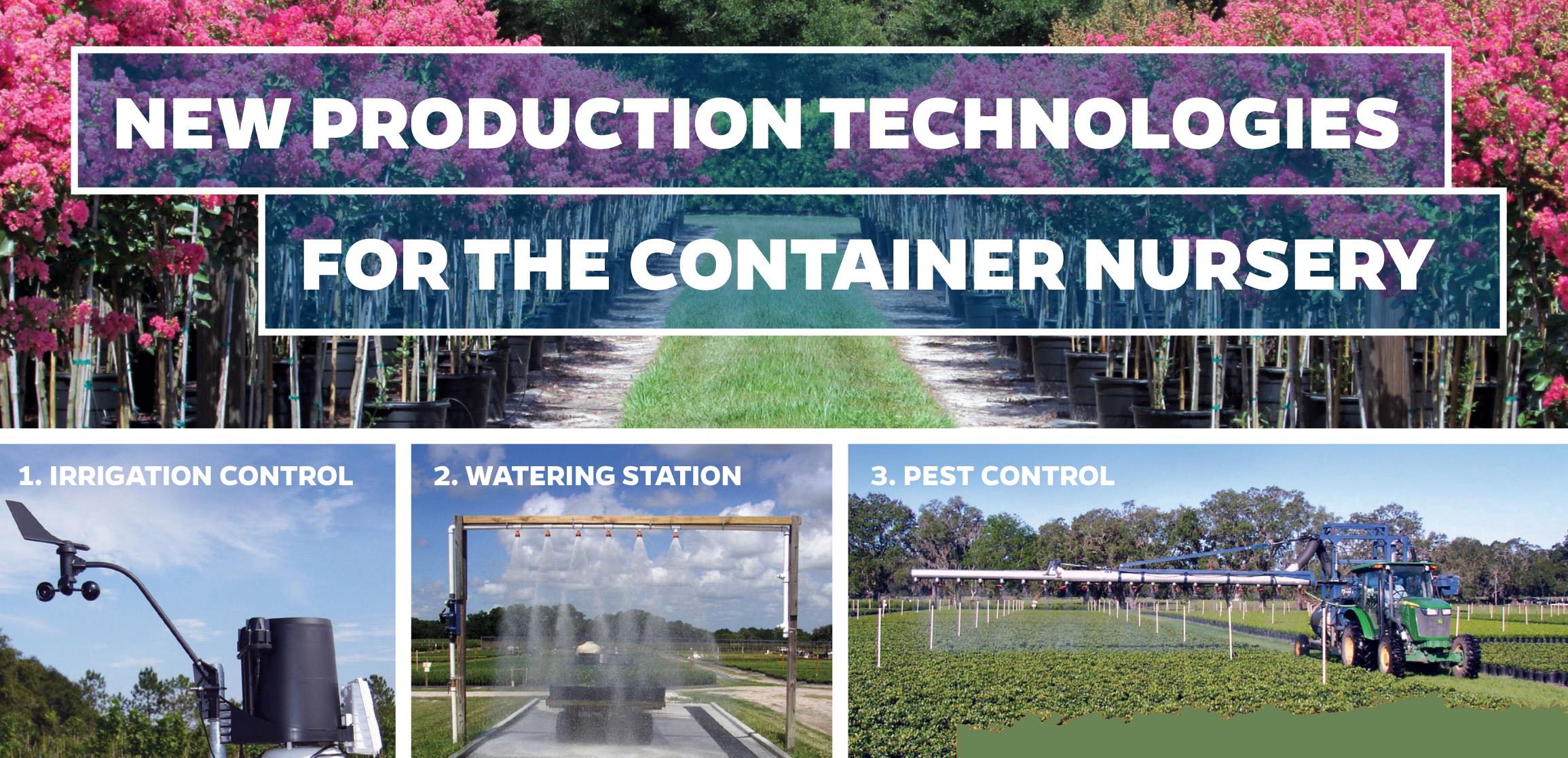
An irrigation control system has been developed at the University of Florida, IFAS. The irrigation control system called CIRRIG uses onsite weather and leaching fraction information to automatically adjust irrigation run times daily. You will learn how CIRRIG works and see plants grown with overhead sprinkler and micro-irrigation.

A watering station is used to irrigate plants immediately after planting. The watering station complies with new Best Management Practice guidelines for mitigating nutrients in runoff water.

Pest control at Hibernia Nursery is accomplished with the Airtec Sprayer. The efficient delivery of pesticides and precision control of pests have reduced costs.

The event will be on December 7, 2017, at 09:00 and run until 13:30 with a lunch being served.  Tickets are free but you must preregister for a spot.  Registration is limited to 40 people
and closes Dec. 5, 2017. Please register to receive lunch.  Here is the link if you would like to attend.  www.tiny.cc/Hibernia_BMP

Here is the agenda...
9:00 a.m. - Check In
9:15 a.m.  - Introductions and Overview of Technologies
10:00 a.m.  - Visit Field Sites
12:15 p.m.  - Lunch
1:00 p.m.  - Concluding Comments

The location will be at HIBERNIA NURSERY 1176 C. 478A, Webster, Florida 33597

Participants requiring special accommodations contact 352.569.6862 five days prior to event.

11/14/17

New Production Technology Field Day


Join us for a field day at Hibernia Nursery where UF/IFAS Extension will demonstrate new production technologies in irrigation, watering stations and pest control.

An irrigation control system has been developed at the University of Florida, IFAS. The irrigation control system called CIRRIG uses onsite weather and leaching fraction information to automatically adjust irrigation run times daily. You will learn how CIRRIG works and see plants grown with overhead sprinkler and micro-irrigation.

A watering station is used to irrigate plants immediately after planting. The watering station complies with new Best Management Practice guidelines for mitigating nutrients in runoff water.

Pest control at Hibernia Nursery is accomplished with the Airtec Sprayer. The efficient delivery of pesticides and precision control of pests have reduced costs.

The event will be on December 7, 2017, at 09:00 and run until 13:30 with a lunch being served.  Tickets are free but you must preregister for a spot.  Registration is limited to 40 people
and closes Nov. 30, 2017. Please register to receive lunch.  Here is the link if you would like to attend.  www.tiny.cc/Hibernia_BMP

Here is the agenda...
9:00 a.m. - Check In
9:15 a.m.  - Introductions and Overview of Technologies
10:00 a.m.  - Visit Field Sites
12:15 p.m.  - Lunch
1:00 p.m.  - Concluding Comments

The location will be at HIBERNIA NURSERY 1176 C. 478A, Webster, Florida 33597

Participants requiring special accommodations contact 352.569.6862 five days prior to event.


10/18/17

BMP Projects Wanted

Attention Growers:  UF/IFAS BMP Program is seeking growers with ideas for BMP implementation.  If you would like to implement a BMP project on your farm, UF/IFAS Extension can help.  You pick the project, we collaborate on implementation.  Extension will write the grant.  You get 100% of the cost covered up to $10,000 if it is funded.  Then we have a field day to demonstrate your project.  Please read the information below if you would like to participate.

Request for proposals – BMP Minigrant Program
October 17, 2017
Deadline: November 10, 2018
Introduction
As in past years we are requesting proposals for on-farm demonstrations related to BMP implementation. The deadline for these proposals is November 10, 2017 by reply email. There is no limit to the amount requested, however the target amount is $5,000 to $10,000 each. Grower evaluation of the BMP(s) are critical to this program. Therefore, the proposed project should be for a single year, involve a grower cooperator, conducted on their field and culminate in a grower attended field day. Any applicable BMP can be demonstrated on any crop or animal within a published BMP manual.
Format
The format of the proposal is the same as previous years and contain the following elements: 1) 2 to 4 pages in length, 2) provide the BMP and crop in the title; 3) a background section containing the reason for the proposed demonstration; 4) list of objectives, outcomes and projected impact of the demonstration; 5) complete list of materials and methods; 6) projected field day agenda; 7) description of potential audience (makeup and size) of the field day; and 8) complete budget including all personnel costs (salary and fringe), costs of materials and equipment, and 10% overhead.
Deliverables
The demonstration project should result in a grower field day at the demonstration site, and a final report (due no later than June 15, 2018). The agenda and announcement for the field day must be received at least two weeks prior to the event. In addition to grower invitations; FDACS, NRCS, water management district and other state agency personnel must be encouraged to participate in and attend the grower field day.  The final report must contain a summary of: the demonstration site; interactions with the cooperator; attendance list; final agenda; copies of presentations and handouts; and outcomes. The writing of EDIS documents, magazine articles and other publications are encouraged. The BMP program will assist in writing and publishing of these documents.
Suggested topics
1) Fertilizer rates, 2) irrigation scheduling, 3) use of soil moisture sensors, 4) soil and tissue testing, 5) variable rate fertilizer applications, 6) irrigation automation, 7) use of drone based technologies, 8) fertilizer management with soil electrical conductivity sensors, 9) on-site water retention/treatment, 10) any other applicable BMP

5/13/15

Leaching Fraction Explained

In case you missed the class on container irrigation we had this week, learning about how to conduct a leaching fraction is a great tool to get to know.  This super-simple method will give you the confidence to irrigate effectively to reduce excess pumping, reduce the amount of fertilizer needed to grow a plant, reduce pesticide use and grow quality plants.   It will also give you an accurate amount of time to tell people to run the irrigation system depending upon the changes in weather, season, plant size, etc.
A leaching fraction is simply the amount of water that leaves the container after you run irrigation divided by the total amount of water that was applied and captured by the container during irrigation.  The last number is arrived at by subtracting the weight of a dry plant before irrigation from a wet plant after irrigation.  This simple equation creates a number, the leaching fraction.  When multiplied by 100 will give a percent.  The Water Quality/Quantity Best Management Practices for Florida Nurseries manual states that the leaching fraction percent should be 10-15%.  If the number is extremely low say 0-5% you may be under-watering plants.  If the number is higher than you are over-watering plants.  You can easily do this with buckets attached underneath the pots you are growing, randomly scattered in your field.  This can be easily done for small annual containers to large containers with a slight modification on catching the leachate.  For more information here is a video that can be found in the BMP Manual  http://www.freshfromflorida.com/Media/Files/Agricultural-Water-Policy-Files/Best-Management-Practices/Nursery-Videos/Video-8-Leaching-Fraction  If you would like to see the rest of the Florida Nursery manual here is a link to that  http://www.freshfromflorida.com/content/download/37570/848371/NurseryBMP.pdf  If you would like help setting up a leaching fraction and interpreting the results, contact Shawn at UF/IFAS Extension Hillsborough/Polk County ststeed@ufl.edu for a nursery visit.

8/15/12

Important For Polk County Ag Producers !!!

A stormwater assesment fee will be assesed for properties in unincorporated Polk County.  If you are an agricultural producer, specifically an ornamental nursery or sod producer in Polk County now is the time to sign up to implement Best Management Practices on your operation.  For folks to be exempted or receive mitigation credits, they need to apply before September 13th for the credit to make this year’s tax billing.  In order to sign up for the BMPs it only takes a short visit (1.5 hours) from myself and Jemy Hinton with the UF BMP Implementation team/ FDACS to get you signed up. Just call me at Polk County Extension office 863-519-8677 or email me at ststeed@ufl.edu  
 Please read the information below on the Stormwater Assessment and the rules on the credit.

In response to federal and state mandates for local governments to improve the quality of stormwater runoff, on June 26, 2012, Polk County adopted a Stormwater Assessment Ordinance and preliminary rates to be assessed on lands in unincorporated Polk County. Florida Statues provide a 100 percent exemption to the stormwater assessment for agriculture properties that meet certain conditions.


Bona fide farm operations on land classified as agricultural land pursuant to section 193.461 F.S. will be exempt from the assessment if the farm operation provides documentation to the county that the operation has a National Pollutant Discharge Elimination System Permit, Environmental Resource Permit, Works-of-the-District Permit or Implements of Best Management Practices adopted as rules under Chapter 120 by the Department of Environmental Protection, the Department of Agriculture and Consumer Services or a Water Management District as part of a statewide or regional program. This exemption is not automatic. You will need to submit a mitigation credit application following its instructions to provide the necessary documentation to be exempt from this assessment.

To obtain a copy of the county’s mitigation application, or if you have any questions regarding this issue, please contact the Polk County Parks & Natural Resources Division at (863) 534-7377. After August 20, 2012, the county’s mitigation application will be available online at www.polk-county.net. Please follow the indicated links to obtain the application. However, we would encourage you to apply now if you meet the necessary conditions to be exempt.

11/1/11

Nursery Production Water Webinar Series

Water, water, everywhere!  This is an awesome educational opportunity for growers.  The Water Education Alliance for Horticulture is working with University of Florida Cooperative Extension, OFA, FNGLA, the German grower association Zentralverband Gartenbau and several experts at universities and companies on webinar topics to help growers conserve, recirculate, and treat irrigation water.
This is a great opportunity to sit at your own computer for lunch and get the latest information from around the world on a variety of timely water topics.  The technology is very easy to use so don't get intimidated.  You will click on a link and join the webinar.  Just make sure that your computer has speakers or you have a phone that can call for the audio.  It couldn't be any simpler to get UF Extension education. 

Registration is free at watereducationalliance.org (click on “workshops”), and 45-minute presentations will run at noon EDT on the following Tuesdays

29-Nov   Best Management Practices for water conservation Tom Yeager (University of Florida)

6-Dec   Biology of waterborne pathogens Gary Chastagner (Washington State University)

13-Dec   A Systems Approach for Managing Phytophthora Diseases in Nurseries: the Importance of Water. Jennifer Parke (Oregon State University)

20-Dec   Monitoring water quality Paul Fisher (University of Florida)

10-Jan   Filtration and avoiding clogging of irrigation lines (Dramm Water)

17-Jan  Surface cleaning and sanitation Warren Copes (USDA-ARS)

24-Jan  Algae control and pond management Ken Wagner (Water Resources Services)

31-Jan  Pro and cons of water disinfection techniques: A European perspective Walter Wohanka (Geisenheim Research Center, Germany)

7-Feb  Designing water treatment systems Paul Fisher.

If you are a nursery producer and irrigate plants then I hope you will take the time to learn more about some of these topics.  If you have any questions please call Shawn at 813-629-6104.

3/17/11

Agricultural Pesticide Use in America

Here is a new publication from UF/IFAS about the amount and trends of pesticide use in agriculture in America from EPA data. The publication was not interpreting or drawing conclusions based on the numbers just stating the numbers as facts.


The data shows that the US spent $7 billion on pesticides in each of the years 2006 and 2007. Herbicides accounted for more than half of those expenses. There were more than 600 million pounds of active ingredients applied with over half of that being herbicides. Remember that when you buy pesticide only a fraction of the total is actual active ingredients the rest is either inert or a carrier of some type to deliver the pesticide. It got me thinking about how much pesticide is that really. I could probably fit a ton of active ingredients (a.i.) in my pickup truck. So that would be about 300,000 trucks full of active ingredients. Or two pounds of pesticide a.i. for every man, woman, and child in the US, or 0.265 lbs a.i. for every acre of land in the US. Interesting! Where does all the pesticide go every year? Any comments?

11/17/10

Open Letter to Agricultural Producers about EPA Numeric Nutrient Criteria

Here is an open letter from
the Commissioner of Agriculture Charles Bronson and Micheal Sole the Secretary of the Florida Department of Environmental Protection encouraging all agricultural producers to sign and implement the Best Management Practices for their respective operations. Just click on the link below to read the letter.

The EPA has finalized the levels for nutrients that are allowed in the waterways of Florida in order to meet water body standards of quality and reduce the amount of impaired water bodies in the state. The new standards will go in effect 15 months from now. This will require stakeholders to implement plans and remediate affects of nutrient runoff to waterways. As a producer you will eventually either verify that you are not causing nutrient runoff from your nursery or sign up and follow the FDACS Best Management Practices for Nurseries. This is extremely important that you sign up with the BMPs if you haven't done so already. You can call me to talk about it or Jemy Hinton 813-478-6630. This regulation will have far reaching consequences and as a producer you need to be proactive to minimize risk. Here is more information from an article from Growing Produce http://www.growingproduce.com/news/?storyid=4644 and here is a publication from UF about the entire Nutrient Numeric Criteria regulation entitled, "A Guide to EPA's Proposed Numeric Nutrient Water Quality Criteria for Florida" http://edis.ifas.ufl.edu/pdffiles/SS/SS52800.pdf

5/19/10

New Uses For Old Bathtubs

On a recent visit to Speedling Inc. we were shown a brilliant use of a used bathtub. Here is a mixing station that they use to mix chemicals and capture any run off form the mixing process. Notice the ventilation on the top and the scale affixed above the capture area. Also, notice the five gallon bucket that is at the drainage end of the old bathtub. This is a great way to avoid potential contamination and accumulation of small amounts of pesticides that build up over time through continual mixing in one location. Thanks Speedling staff for sharing that with us!

Jemy Hinton with UF BMP program also suggests a small kid pool that can capture potential spills from the mixing process. If you are mixing small quantities this might be a good tip for reducing potential chemical problems in the environment.
I have seen another good use for a old metal bathtub at another nursery. Doug Meyers uses an old bathtub as a radiator/fire pit and burns wood in it at cold winter night meetings at his nursery. I have seen it in action and it works great.
Let us know if you have any other good uses for old bathtubs in the nursery.

3/1/10

Integrated Pest Management Update


Pests are a perennial problem in the nursery and their proper identification and effective control are essential to best production practices. The University of Florida/IFAS extension is bringing you a great program on the latest and greatest from research and industry to help you in your combating pest at the production level.

We will be having our annual Integrated Pest Management Update in Balm at the Gulf Coast Research and Education Center. The session will be half a day and will cover topics in the following areas:


  • how to effectively scout your production area
  • two economically important weeds
  • weed management
  • industry updates from our sponsors
  • shipping plants to and from Texas
  • chilli thrips management
  • banker plants
  • biorational pesticides

This is a really good line up and you should take away some good information to put to immediate use at the nursery. The cost is $25.00 and will cover refreshments, materials, CEU's for FNGLA, ISA, and FDACS pesticide licenses.

Here is the flyer for the program: http://hillsborough.extension.ufl.edu/Ag/AgOrnProd/CalendarPubs/PMUFlyer2010.pdf

And here is the link to register yourself online. http://ipm030910.eventbrite.com/


2/9/10

Numeric Nutrient Criteria

Most of you have already heard about the proposed EPA numeric nutrient criteria. You also probably know that it can have a major impact in your daily business life. The EPA is giving us guidelines as to how clean the water that leaves your farm needs to be. If the water does not measure up to the standards then measures to monitor and treat this water would be necessary. If you have already signed up for the Nursery Best Management Practices (BMP)you have a waiver of liability if you follow the practices and are found to be in violation of the standards. If you have not signed up yet...SIGN UP NOW!!! Call Jemy Hinton at 813-478-6630. She will walk you through the painless process and can even help you get cost share money to improve your production practices.

And for a reference guide to understand all this talk about the numeric nutrient criteria, IFAS has just published a handy guide to help you understand what is going on and how to be in on the process. Just click on the link below for A Guide to EPA's Proposed Numeric Nutrient Water Quality Criteria for Florida: http://edis.ifas.ufl.edu/ss528

12/10/09

Water Quality and BMPs


In case you have been working too hard to sell your plants you may have missed all the commotion about our water quality. There are fertilizer ordinances being proposed and passed for homeowners to reduce the amount of nitrogen and phosphorus (N and P) that is leaching and running off their lawns and finding its way into our local waters. As part of this clean up of water quality, the EPA and the FL DEP are jostling to see just who will mandate and what levels are considered the limit for bad water quality in the state of Florida. This is to insure that our impaired waters are brought back to a clean, manageable level.


If you have not yet signed up to follow the BMP's (Best Management Practices) for container nurseries you really should. This gives the grower the right to be considered to be compliant with water quality standards with water leaving the farm. If you don't sign on to the BMP's you may be required in the future to prove that you are not causing adverse effects from your operation. The BMP's are a way for our industry to govern ourselves without an external governing agency doing that for us.


In the continuing saga of these regulations, here is the latest update from Ornamental Outlook:


The EPA is working on new regulations that would set surface water pollution standards for Florida. Capital costs to help abide by the proposed standards could prove devastating for Florida’s economy, especially for those in the agricultural sector. The deadline for setting the new standards is closing in


Industry organizations are going all out to stop the regulation that could go into effect as early as October 2010.
The Florida Nursery, Growers & Landscape Association (FNGLA) and other agricultural groups have teamed up with business interests to form the Florida Water Quality Coalition. The coalition is taking proactive steps in helping stop this regulation including:
Consulting with legal counsel to challenge EPA's entire process in the courts
Working with specific interests to mount a highly prolific grassroots and public relations campaign
Collaborating with Florida's Congressional delegation to develop targeted legislative solutions to remedy this situation
The FNGLA and the coalition are asking all of its members, all of those in the Florida nursery and landscape industry, and even concerned citizens to contact their Members of Congress with the following message: EPA must reconsider and withdraw its decision requiring only Florida to adopt the numeric nutrient standards by the Jan. 14, 2010 deadline.
Go to
http://donttaxflorida.com/ to learn more about this important issue.


Growers should stay up to date on this issue and should get on board with the BMP's.


Here's what Dr. Tom Yeager of UF/IFAS has to say about the BMP's:


As provided for by statutory rule, BMPs for container nursery crops will provide a waiver of
state-imposed liability for cleaning up contaminated surface or ground water provided the
owner or nursery operator has done the following:

• Filed a notice of intent with the Florida Department of Agriculture and Consumer Services (FDACS)
• Implemented and carried out the appropriate BMPs
• Maintained the necessary records of using BMPs.
The waiver is provided on the premise that a nursery operator is using the best production
practices. Therefore, water leaving the nursery property is presumed to meet state water-quality
standards and will not impair the natural waters of the state.
Additional benefits of using BMPs include:
• Protection from duplicate regulations at the local level
• Eligibility for USDA Natural Resources Conservation Service and possibly other cost-share
funds for retrofitting or implementing water-conserving irrigation systems
• Improved production efficiency and possibly reduced production costs
• A demonstration that the nursery industry can exercise its ability to determine what are the
“best” cultural practices and voluntarily use these practices rather than be confronted with
mandatory regulations.


Here is a link to the BMP manual for container nurseries.


If you would like to see what money is available to you after you sign up with the BMP's please refer to my previous posts under the label GRANTS.


If you would like more information please call me at the Extension office 813-744-5519 ext.147. Or you can call Jemy Hinton at 813-478-6630.


11/13/09

Regulatory meeting

The Farm Bureau of Hillsborough County and IFAS will be hosting a meeting on the latest regulatory information affecting growers. Here is the information.


You are invited to attend a regulatory update meeting where you will have the unique opportunity to hear from and interact with three of the most knowledgeable authorities on water, natural resources and Agricultural Best Management Practices in the state:

Jerry Brooks
Director of Environmental Assessment and Restoration, FDEP,
David Moore
Executive Director, SWFWMD

and Dr. Brian Boman, UF/IFAS BMP Implementation Program


This meeting will be held on November 18, 2009 at 6:30 p.m. at the John Trinkle Bldg (HCC Campus, 1206 N. Park Rd. Plant City, FL
Don’t miss this chance to discuss the EPA numeric standards and their impact to agriculture.
Please RSVP to: Judi Whitson (813)685-9121

10/15/09

Save Water and Money Producing Plants

We had a great TBWG meeting at Riverview Flower Farm. Part of it is seeing the production methods of R.F.F. and the innovation that takes place there. The other part was our guest speaker Dr. Mike Dukes from UF. He spoke about Smart Water Application Technology(SWAT). Part of that is reducing water from a timed application of water and moving to a needs based application of water. Some of the technological advances to reducing this water is by using rain sensors, soil moisture sensors and evapotranspiration controllers. These devices will bypass an irrigation timer if the plants do not need the water (e.g. after a rain event). Dr. Dukes' had two years of research looking at homeowner lawns and these technologies have saved the homeowners from around 40-70% water savings.


One of our own local growers James Reed at Three Pines Tree Farm is using a soil moisture sensor for his irrigation and says even without the grant he received to put it in place, he will have the device paid for in about 14 months from savings on his pump usage. He will also be saving thousands of gallons of water from our aquifer and many pounds of fertilizer will not be wasted or leached into the ground. This technology is really helping James' operation tighten up costs and reduce waste thereby making him more competitive in the marketplace.


If you would like more information about SWAT Dr. Dukes has some information on his website http://www.irrigation.ifas.ufl.edu/

If you would like more information on saving water or getting a grant for your farm to utilize this technology send me an email or give me a call at the extension office.

7/31/09

Worker Protection Standard Inspections


No producer relishes the thought of having a Worker Protection Standard Inspection. But it's the law and all producers that apply pesticides and have employees must comply with that law and pass inspection. I recently talked with Mike Pikus from the Florida Department of Agriculture & Consumer Services about inspections and how nursery and greenhouses fared during those inspections. He said they fared well, but he cautioned that he wished most operators read pesticide labels more closely. In specific he was talking about the personal protective equipment (PPE) that mixers/loaders, applicators, and workers that enter the treated area during the restricted entry interval (REI) must wear to comply with the label and the law. He said this is where some operator's err. Especially people that enter an area that has been sprayed or workers pulling plants for shipping before the REI is over. The label states what PPE must be worn if someone needs to enter the treated area before the REI has elapsed. I asked if there was a common place that throughout his inspections he commonly found problems with. He said generally there was not a commonly missed area during inspections. I also suggested that maybe we post the checklist that he goes through in order to conduct an inspection. He agreed that it would be a good idea and said that if an operator that falls under the WPS and can answer the affirmative in all those questions there shouldn't be a problem during an inspection. If you would like to look at a link to the inspection checklist here is the site. You can find it here and the publications page of my extension website.

http://hillsborough.ifas.ufl.edu/documents/pdf/ornamental_production/A-Z_pubs/WPSInspectionChecklist.pdf
Also keep watching this page for future trainings and workshops on Train the Trainer and the WPS how to comply. Also, don't forget to check out the mini-FARMS grant program in a previous article on this site for help with getting money to build structures that protect the aquifer such as pesticide mix stations or storage facilities.

7/9/09

The IFAS Pesticide Information Office


IFAS has a great resource for growers who might need information pertaining to pesticide use and safety. The UF/IFAS Pesticide Information Office's website is a great resource to bookmark for use some day in the future. There are links on their site to topics such as pesticide laws, fact sheets, and their newsletter "Chemically Speaking." They also have links to sites where you can download MSDS sheets and chemical labels that you need for the Worker Protection Standards. If you are wondering what else you need to pass an inspection with the Worker Protection Stardard, they have the answers in a one-stop-shop. You can scroll through topic by topic to see if you meet all the requirements necessary. Also if you need CEU's in a hurry for you licence, you can download them from the UF/IFAS site and get online credit with their modules. By far, the most useful information they have are the links to the EDIS (Electronic Data Information Service) fact sheets and publications. There is a wealth of information on here and it would be well worth your time just to spend a few minutes checking it out to see what they have available. Here is the link: http://pested.ifas.ufl.edu/.

6/2/09

The Health of Ag Farmers and Families

Have you ever wondered if farmers are more apt to get chronic illnesses from applying pesticides? Well here is a study that looks at pesticide applicators versus the non farm population. Dr. Fred Fishel has summarized the findings of the Ag Health Study which has looked at this question for some years.

The study is being conducted in Iowa and N. Carolina and with collaboration between the National Cancer Institute, the National Institute of Environmental Health Sciences, and the Environmental Protection Agency. The study has looked at 89,000 participants to investigate the effects of environmental, occupational, dietary, and genetic factors on the health of the agricultural population.


Some of the findings are that farm families had more pesticide residue within the home than non-farm families. This suggests that farmers or their families are bringing pesticides into the homes via contact with pesticides or material that has contacted the pesticides.


Another study connected diabetes to those who used seven pesticides: aldrin, chlordane, heptachlor, dichlorvos, trichlorfon, alachlor, and cyanazine. The study also reaffirms the link between obesity and diabetes.


Although some of the findings are not good, it was found that farmers are generally healthier than their non-farming counterparts and farmers have a lower risk of colrectal cancer.

I believe that as farmers we should try to find ways to better protect the health of our selves, families, and communities. Use this information to minimize contact with pesticides, follow the label for proper pesticide use, use BMPs, follow restricted entry intervals, and protective equipment. And just food for thought...you might want to kick off your shoes before entering into your house. This simple step might prevent pesticides associated with soil from entering into your home. For more information on this topic, here is the link to the IFAS EDIS summary is http://edis.ifas.ufl.edu/pdffiles/PI/PI21600.pdf and the link to the agricultural health study is http://aghealth.nci.nih.gov/.