Showing posts with label pest management. Show all posts

4/13/26

Managing Foliar Leaf Spots in Viburnum Production: What Florida Nursery Trials Reveal


Viburnums are a cornerstone crop for many Florida nurseries, but over the past two decades growers have faced increasingly severe foliar disease problems—especially during propagation. What was once a nearly trouble‑free crop has, in some cases, dropped from near‑100% propagation success to total loss. Extension and research by UF/IFAS and funding help from the Florida Nursery Grower and Landscape Association help explain why—and what growers can do to protect their plants.

It’s Not Just Downy Mildew Anymore

For years, downy mildew (DM) (Plasmopara viburni) was considered the primary culprit behind leaf spots, blighting, and defoliation in viburnum. But UF/IFAS researchers found that today’s disease pressure is far more complex. Across multiple nursery trials, they consistently isolated a mixture of true fungal pathogens—including CercosporaColletotrichumCorynesporaPhyllostictaPhoma, and Pestalotiopsis species.
These pathogens produce symptoms nearly identical to downy mildew, making field diagnosis extremely difficult. In fact, in several seasons researchers found no downy mildew at all, even when symptoms looked like classic DM.
viburnum propagation with heavy disease pressure
Viburnum cutting propagation with heavy disease pressure (photo credit: UF/IFAS Extension Hillsborough County)

Why Many Fungicides Fail

Because many growers were targeting downy mildew, they relied heavily on oomycete‑specific fungicides. The trials showed that these products—those containing active ingredients ametoctradin, cyazofamid, dimethomorph, fluopicolide, mandipropamid, mefenoxam, or oxathiapiprolin—did not reduce disease severity when true fungi were the real problem.

In contrast, systemic fungicides effective against true fungi performed significantly better. Products containing active ingredients benzovindiflupyr, difenoconazole, fluxapyroxad, and pyraclostrobin consistently reduced leaf spot severity in both container and propagation trials.

Propagation Trials: Dip Treatments Shine

During propagation, both fungicide drench and dip applications helped reduce disease, but dip treatments had two major advantages:

  • They reduced disease severity without the negative impact on root development seen in some drench treatments.
  • They possibly avoided diluting the rooting hormone, which can contribute to weaker, less vigorous liners.

Postiva® (benzovindiflupyr + difenoconazole) and Orkestra® (pyraclostrobin + fluxapyroxad) were the most consistently effective products across trials.

Best Practices for Growers

The research highlights three key takeaways:

  1. Identify the pathogen—or at least recognize that multiple pathogens may be involved. Misidentification leads to ineffective control.
  2. Use the right fungicide for the right pathogen group. When true fungi dominate, oomycete‑targeting products won’t help.
  3. Reevaluate production practices. Overhead irrigation, high humidity, and dense canopies create ideal conditions for foliar pathogens. Reducing leaf wetness—especially in propagation—can dramatically improve outcomes. Creating less stress (possibly with some shade) can also help plants fight diseases.

While fungicides remain an important tool, cultural practices and clean stock are equally critical. With better pathogen awareness and targeted management, growers can regain control over viburnum production and reduce costly losses.

For more complete information, publications of the multi-year research findings were published in the Florida State Horticulture Society Proceedings and summarized for nursery growers and propagators in the publication Foliar Leaf Spots of Viburnum during Nursery Production in Florida: Research and Fungicide Efficacies

Disclaimer

UF/IFAS recommends following all pesticide labels. The label is the law. The selection and use of these products over any other products do not indicate an endorsement. During the preparation of this work, the author used Copilot to summarize research findings. After using this tool, the author reviewed and edited the content as needed and takes full responsibility for the content of the publication.

1/29/26

FNGLA Lake Region Meeting in Bartow 2/3/26 Chili Cook Off and Pest Update CEUs

Make sure to drop in to our Annual Chilli Cook Off for some good cookin' and a pest update (A CEU if you need one of those also).


1/10/25

Two-spot Cotton Leafhopper Pest Alert

A new pest has been found in the Tampa Bay area that might affect your nursery plants. 

photo credit -USDA by Nisael J. Nieves López;

Pest Alert: Two-Spot Cotton Leafhopper

The two-spot cotton leafhopper (Amrasca biguttula), a significant pest of cotton, okra, and eggplant, has recently established itself in the Caribbean Basin. This pest, also known as the “cotton jassid” or “okra leafhopper,” was first detected in the U.S. Virgin Islands and Puerto Rico in the spring of 2023.

Photo by Daphne Zapsas, USDA-APHIS-PPQ, Biological Science Laboratory Technician, Miami, FL.

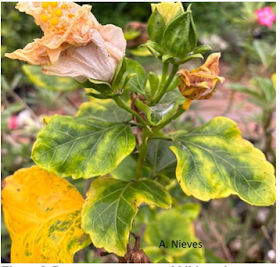
Description and Damage: The two-spot cotton leafhopper is a tiny green insect with distinctive dark spots on its wings and sometimes on its head. These pests feed on the lower surface of leaves, causing a condition known as “hopperburn,” which leads to yellowing, reddening, browning, wilting, and curling of leaves. The damage can be extensive, with yield losses exceeding 50% in some crops.

Photo by Alondra Nieves, graduate student, UPRM, PR.


Photo by Brittany Atkinson, Manatee County Community Gardens Program

Hosts and Economic Importance: This pest affects a variety of crops, including cotton, okra, eggplant, sunflowers, and roselle. However, it also poses a threat to ornamental plants, particularly certain cultivars of hibiscus. While some hibiscus varieties may only be lightly colonized, others can suffer extensive damage, impacting their aesthetic value and health.  This pest also feeds on marigolds in the Asteraceae family, mulberry in the Moraceae family, as well as some members of the grass family. 

Distribution and Action: The two-spot cotton leafhopper is native to the Indian Subcontinent but has spread to the Caribbean and several Florida counties. If large numbers of leafhoppers are found, samples should be sent to the Florida Department of Agriculture and Consumer Services for identification.

Conclusion: The establishment of the two-spot cotton leafhopper in the Caribbean and Florida poses a significant threat to both agricultural and ornamental plants. Early detection and proper management are crucial to mitigate the impact of this pest.

For more information or to report sightings, contact the Florida Department of Agriculture and Consumer Services at DPIHelpline@FDACS.gov or 1-888-397-1515

References :

USDA APHIS, 2023.  Amrasca biguttula (Ishida) (Hemiptera: Cicadellidae) Indian cotton leafhopper.  Amrasca biguttula 18x24 PPQ.pdf

FDACS  DPI, 2023.  Two-spot cotton leafhopper, Hemiptera: Cicadellidae, Typhlocybinae, Empoascini; Amrasca biguttula (Ishida) – A serious pest of cotton, okra and eggplant that has become established in the Caribbean Basin.  PEST ALERT: Two-spot cotton leafhopper


7/26/24

FNGLA Manasota Chapter Meeting + CEUS


The FNGLA Manasota Chapter will be hosting a meeting at the UF/IFAS Gulf Coast Research and Education Center located in Balm, FL on Thursday, August 1, 2024, at 4:00 p.m. until 8:00 p.m.  We will receive a tour of the research center, get environmental horticulture research updates, obtain CEUs, and feast on a tasty dinner. Attendance fee is $20.00 for members/$30.00 for non-members, and $10.00 for students.  This meeting is open to anyone in the green industry.  Click this link to register 

Here is the agenda:

4:00 pm: Arrive

4:15 pm: Tour GCREC Diagnostic Clinic, Dr. Natalia Peres, Professor of plant pathology, UF/IFAS, Gulf Coast REC

4:40 pm: Mites and thrips, Dr. Sriyanka Lahiri, Assistant Professor of entomology and nematology, UF/IFAS, Gulf Coast REC

5:00 pm: Parasitic nematodes, Dr. Johan Desaeger, Associate Professor of entomology and nematology, UF/IFAS, Gulf Coast REC

5:20 pm: Urban water uses, management, and recycling, Dr. Mary Lusk, Assistant Professor of soil and water sciences, UF/IFAS, Gulf Coast REC

5:30 pm: Dinner

5:45 pm: Remarks, Dr. Jack Rechcigl, Professor and Center Director, and Dr. Nathan Boyd, Professor and Associate Center Director

6:00 – 8:00 pm: CEU program - Pest Management Tools and New Varieties for Production and Utilization of Ornamental and Nursery Plants (2 CEUs)

6:00 pm: Management of invasive pest insects in nursery crop production, Dr. Lance Osborne, Professor of entomology, UF/IFAS, Mid-Florida REC

6:25 pm: UV light, chemical control, and biocontrol for thrips and mite management in specialty crops, Dr. Sriyanka Lahiri

6:45 pm: Chemical alternative methods for disease control, Dr. Natalia Peres

7:05 pm: Notes from the field; a pest update, Mr. Shawn Steed, Extension Agent IV, UF/IFAS Hillsborough County Extension Services

7:40 pm: New caladium, lantana, and porterweed introductions for nursery production and landscape use, Dr. Zhanao Deng, Professor of environmental horticulture, UF/IFAS, Gulf Coast REC  

CEUS; 1 Core (487, 482) + 1 O&T, Private, Ag Row, Demo and Res., Commercial L&O.

Any questions please call Shawn Steed at the Hillsborough County Extension Office 813-744-5519.

5/16/23

Do Rice Hulls Prevent Weeds in Woody Ornamental Container Production in a Central Florida Growing Environment?


While making my rounds at various nurseries around the county I am finding more and more managers are utilizing parboiled rice hulls as a source of mulch for early weed control in container woody ornamental plantings.  The question is, "Do rice hulls prove to be both an economical and effective solution for weed control?"  When asking this question, I have a lot of anecdotal evidence of weed suppression during the early growth stage of container plant production, but I have very few facts to back up whether there is an economic benefit when comparing the cost of materials, labor costs and the difference between traditional weeding and a preemergent herbicide.

There is good evidence that rice hulls can reduce bittercress and liverwort when applied at depths of ½” to one inch thick on the surface of container soil (Atland, 2019).  Mulches play a crucial role in inhibiting weed growth by creating an unfavorable environment for seed germination. By covering the substrate surface, mulches restrict the access of small weed seeds to essential resources, such as stored energy and nutrients. However, most mulches eventually decompose and become conducive to weed germination, limiting their long-term effectiveness. 

Effective mulches for container crops should possess specific characteristics, including low nutrient content, quick drying properties, and resistance to decomposition. Rice hulls exhibit these desirable qualities, making them a potentially good choice for preventing the establishment of some weeds.

I have seen sawdust or shredded wood being used at nurseries but when I tested the cost and effectiveness in an experiment, there were no economical and no practical benefits compared to hand-weeding and preemergent herbicides. 

Dr. Chris Marble (UF Weed Scientist) and I did a mulch study and published the results. We found that large pine bark nuggets did well restricting weeds but when compared to thin plastic (the kind used for strawberry or vegetable fields); plastic mulch wins hands down (Marble et al, 2019). 

In another study of plastic mulch for weed control, I demonstrated that plastic mulch almost eliminated weeds, reduced water loss, reduced the need for irrigation, and reduced the leaching of fertilizer (Steed et al, 2018). I did find that plants grew slower in plastic mulch, but I speculate that it was due to the lack of leaching irrigation and a dramatic increase in EC and decrease in pH over the growth time.

Soon we will be experimenting with rice hulls and let you know whether it is a good idea to use them as a weed control method or not. 

References:

Atland, James.  2019.  USDA tests PBH rice hulls for weed control in container crops.  Nursery Management Magazine.

Marble, S. C., Steed, S. T., Saha, D., & Khamare, Y. 2019. On-farm Evaluations of Wood-derived, Waste Paper, and Plastic Mulch Materials for Weed Control in Florida Container Nurseries, HortTechnology hortte, 29(6), 866-873.

Steed, S.T., Bechtloff, A., Koeser, A. & Yeager, T. 2018. Response of Japanese privet to plastic mulch applied over nonspaced containers HortTechnology 28 58-65


12/17/21

Viburnum Diseases


Many growers in Florida face challenges propagating and growing Viburnum species.  Leaf spots, defoliation, shoot dieback and potential death of plants can occur if the environment, weather conditions, and diseases are in the right alignment to favor fungal outbreaks.  Over the last few years our research team (Dr. Gary Vallad and his pathology lab, Dr. Wael Elwakil, and myself) have been working on the identification of disease pathogens and their fungicidal control with the help of an FNGLA Research Endowment Grant.  So, what have we learned from our work?  Here is a summation of the important lessons we have learned.

We thought that downy mildew was the main culprit causing leaf spots blotches and defoliation.  This might be true when the weather is slightly cool, for instance in early spring.  When weather turns to hot and rainy, there are a whole host of other fungal pathogens we identified that cause very similar symptoms on the leaves and shoots.  These fungi are hard to distinguish from downy mildew and require a different approach to which fungicides should be used to control them.    

Our efficacy studies have had mixed results due to the fact we were initially targeting downy mildew with very specific fungicides.  We learned that the other fungal pathogens were better controlled with non-downy mildew, general foliar spot type fungicides.  

We presented this work at our last Grower and Landscape Field Day.  We have also presented these results to the FNGLA in a research report as well as conveying the findings to our colleagues at various scientific and extension meetings.  

For a closer look at which fungicides we used and the results, here is a link to a video we made to better explain our results.  https://www.youtube.com/watch?v=8omLE9yu6q4


10/16/20

Pest Alert Snout Scale

 This alert came in through FDACS.  The pictures at the end are a great resource for identifying scale insects.  Here is a link to the original posting.   https://www.fdacs.gov/content/download/93731/file/PEST-ALERT-Snout-Scale.pdf


7/3/19

Nipaecoccus viridis (Newstead), lebbeck mealybug, (Coccoidea: Pseudococcidae), Updated Pest Alert

This Pest Alert was issued by FDACS on a mealybug with a wide range of hosts...
https://www.freshfromflorida.com/content/download/84014/2481005/pest-alert-nipaecoccus-viridis.pdf

INTRODUCTION
The first report of lebbeck mealybug in Florida occurred in 2009 where Cooperative Agricultural Pest Survey (CAPS) Specialists Andrew Derksen (DPI) and Karolynne Griffiths (USDA) collected this New Western Hemisphere Record on November 13, 2009 from Palm Beach County on host plant dodder, Cuscuta exaltata. Since then there are 89 records of this species from over 40 host plant species in four counties in Florida (Broward, Martin, Miami Dade, Palm Beach) (FDACS-DPI database). On June 14, 2019, a citrus sample with lebbeck mealybug was collected by Lauren Diepenbrock (University of Florida) (E2019-3408-1) in Highlands County, Florida after noticing heavy infestation of white wax on branches and citrus fruits (Fig. 1). This find represents a new county record and is the first occurrence of lebbeck mealybug in commercial citrus.

DESCRIPTION
Approximately 4 mm long by 3 mm wide with body color black, purple to blue green with thick white or pale-yellow wax. Females produce an ovisac (Fig. 1) with a wax that is sticky when touched. In high densities (Fig. 1), waxy secretions may appear as a continuous layer of wax which will obscure individual mealybugs. Wax may turn yellow in older infestations. Specimens do turn black in 70% alcohol. This might be a good, quick field diagnostic, but species confirmation will require slide mounting (Stocks and Hodges 2009). For pictures visit the link above.

HOST PLANTS AND GEOGRAPHICAL DISTRIBUTION
 It has been reported from over 45 host plant families including several species of citrus from at least 63 countries all over the world. (García Morales et al., 2016).

ECONOMIC IMPORTANCE
This is an agricultural pest in many parts of the world on a variety of agricultural crops. In Florida, citrus, cotton, ornamentals and tropical plants would all be potential impacted crops. In citrus growing areas of Jordan, where this insect had been a pest prior to introduction of biological controls, it caused such extensive damage that groves were burned in an effort to eradicate it (Stocks 2013). Losses in citrus groves are mainly due to premature fruit drop. In South Africa, infested citrus acreage demonstrated losses of up to 50% of the crop (Cilliers and Bedford, 1978).

1/28/19

BASF Meeting at Extension Hillsborough County


Join us at the Extension Office as we discuss weeds and pests with guest speakers from UF/IFAS and BASF!


6/8/18

Pest Alert: Hibiscus Bud Weevil


Photograph credit: Paul Skelley, FDACS-DPI and anonymous grower

A new pest that attacks buds of hibiscus has been found in Florida in Miami-Dade, Broward, and Hernando Counties.  The Hibiscus Bud Weevil (Anthonomus testaceosquamosus Linell) is gray and about 5 mm in length.  The adult lays eggs on the buds of plants in the hibiscus/mallow family (Malvaceae).  The developing larvae eats the new buds and causes flowers to prematurely abort.  Growers should check plants for yellowing and dropping of new flower buds.  For more information here is a factsheet on the pest from FDACS.
 https://www.freshfromflorida.com/content/download/80995/2339573/Anthonomus_testaceosquamosus_Linell__hibiscus_bud_weevil.pdf

5/18/18

Woody Ornamental Production Field Day Registration Now Open

Make plans to attend UF Extension's Woody Ornamental Production Field Day on May 31st, 2018 at the UF Gulf Coast Research and Education Center.  We have another great line-up of education and field demonstrations prepared for you.  Topics will include, chemical updates from chemical industry reps, pre-emergent herbicide trials on ageratum and tropical plants, updates from a plastic mulch trial, comparison of pH and EC collection methods for large container production and more!  The final agenda is now complete. The times will be 9:00 - 4:00.  Registration will include a lunch and CEUs (1 Core and 2.5 PRVT/O&T).  You can register for $55.00 now at this link to reserve your spot.
https://www.eventbrite.com/e/2018-woody-ornamental-production-field-day-tickets-45941613603

Here is the agenda for the event.
Classroom
8:30       Registration, set-up, conversations over snacks
9:00       Welcome, Introduction, Orientation 5 min.  (Mr. Shawn Steed)
9:05       Plastic Mulch Update 15 min.  (Mr. Shawn Steed)

Field Demonstration
9:25         Bio-Mulch for Containers 15 min. (Dr. Chris Marble)
9:40         Irrigation Using Leaching Fraction for Large Containers 20 min.  (Dr. Tom Yeager)
10:00 Nutrient/pH Monitoring in Large Containers 20 min (Mr. Shawn Steed)
10:20 Ageratum Control in Nursery Containers 20 min.  (Drs. Nathan Boyd/Chris Marble)

Classroom
10:45 Chemical Updates 30 min. (Various reps)
11:15 SWFWMD Permitting Process 40 min. (SWFWMD Staff)

11:55 Vendor Visits / Lunch

12:40 OSHA Fit Test 50 min.  (Mr. William Tomlin, USF Health)
13:30 Alternative containers 20 min.  (Dr. Andrew Koeser)
13:50 Break
13:55 Tropical Plant Herbicide Options 20 min.  (Dr. Nathan Boyd)
14:15 DOT Rules and Regulations update 40 min. (Tpr. Austin Daniels)
15:55 Summary/Evaluation (Mr. Shawn Steed)
16:00 Adjourn

We thank our sponsors, Diamond R, Southern Ag, Mosaic, FNGLA Tampa Chapter, BASF, Syngenta, SWFWMD, USF Health, USDA Southern SARE for making this event possible!

2/16/18

Update from Syngenta

Syngenta has a few new crop protection chemical updates that I would like to share with you.

Advion Fire Ant bait is available for nursery and horse pasture use.  Until new Advion packaging hits the market, nursery users need to have the supplemental label (attached) in hand.  Advion is a new mode of action for fire ant control, and typically eliminates treated fire ant colonies in 24-48 hours.  The USDA Red Important Fire Ant quarantine treatment approval is pending and expected soon. 

Subdue Maxx is now labeled for vegetables and herbs.  This fits in to market expansion with edible plant production, and adds a valuable tool for Pythium, phytophthora and downy mildew control.

11/22/17

Fall Ornamental Pest Update--From Syngenta

This information is provided from Lee Bloomcamp with Syngenta which I am relaying to you. If you would like to find more information about a specific pesticide label you can visit this site <http://www.cdms.net/Label-Database>.

Disclosure -The use of trade names or registered products in this publication is solely for the purpose of providing specific information.  UF/IFAS does not guarantee or warranty the products named, and references to them in this publication do not signify our approval to the exclusion of other products of suitable composition.  All chemicals should be used in accordance with directions on the manufacturer's label.  Use pesticides safely.  Read and follow direction on the manufacturer's label. 

Weather extremes have had significant impact in Florida in recent months.  Heat, drought, monsoons and hurricanes have affected nurseries all over the state, and pest and disease management problems continue as well.   Current issues are addressed below.

Insects

This time of year it is not unusual to find  large white grubs in both in-ground and container tree and shrub roots.  The grubs are immature scarab beetles, mostly Masked chafers, Green June Beetles, and May Beetles, some have multiple-year life cycles.  Adult beetles deposit eggs in moist rich soils, and  irrigated areas full of peat, bark and juicy roots attract egg-laying females.  Grubs feed all summer, then move to the soil surface to pupate in the fall, making them more visible to growers. The mature grubs are hard to kill since they are not eating- DuraGuard drenches may work, but most treatments are not cost effective.  Best strategy for control starts in early summer.  Adult beetles emerge in spring, then mate, and lay eggs.  May-early July drenches of Mainspring GNL or Flagship or other labeled products readily control smaller grubs, preventing root damage and plant stress.   Entomopathic nematodes and milky-spore bacteria are also used in grub IPM programs.  Scarab beetles often return to the same areas to breed, so watch for grubs and root damage and prepare for drenches next year.

Red Imported Fire ants increase activity in the fall.  Less rain, cooler temperatures and plenty of food stimulate colony growth.  Broadcast baits are the best way to control RIFA in areas larger than ½ A.  Award II is labeled for nurseries, and Advion RIFA bait can be used around structures, lawns and non-production areas.  Advion is extremely fast and effective, and will be available for use in nurseries soon.  Treating for RIFA  now will reduce winter survival, and lead to fewer ant problems in the spring.

Diseases

‘Tis the season for mildew, both Powdery and Downy.  Cooler evenings, mature foliage and drier weather all promote these diseases.  Both can be hard to identify, and easily mistaken for other problems.  Many species get powdery mildew, and downy is expanding its host range as well.  Attached are recommendations for both.  Downy mildew is a big problem on basil- Micora, Subdue Maxx and Heritage are all labeled for control of DM on this crop.  Most DM products also control phytophthora.

2/3/17

Whitefly Update with Dr. Lance Osborne

I have seen a few more whitefly infestations around greenhouses late last year and early this year and some of them have been the more resistant Q-biotype.  I thought I would let you know about this opportunity being offered in Manatee County from Commercial Horticulture Agent Martha Glenn.  You can also gain a few Core CEUs.  If you have any questions follow the link below.


4 CEUs at Whitefly Hort Talk

Feb. 16 from 9:00am - 1:00pm
$25 includes
 a mid-morning snack

Dr. Lance Osborne, Professor of Entomology, Associate Center Director, University of Florida, Mid-Florida Research and Education Center in Apopka, presenting information on Whiteflies.  Dr Osborne is an expert and conducts ongoing research on whiteflies.

Whiteflies feed on more than five hundred species of host plants. If proper management steps are taken, a healthy landscape can be maintained. There are a number of cultural, biological and pesticide strategies that can be effective to help manage whiteflies.

Core topics will also be presented.

CEUs applied for 2 - 487 and 482 Core; 2 PVT, 2 LLO, 2 LCLM, 2 O&T, 2 Nat. Areas, 2 ROW

Register Here

7/6/15

Increase Your Pest Management Solutions Through Surveys

Here is your chance to weigh in on the spending of some of your tax money to help pest management options on ornamental plants.  The IR-4 Program is a cooperation of USDA and EPA to expand pesticide labels so more control options are available to growers to manage pests through collection of residue and efficacy data in support of the registration or reregistration of minor use pesticides.  A survey is available to voice any concerns you have in controlling particular pests on certain crops. The survey is extremely brief and will take only a few minutes to complete.  See survey information below.

Ornamental Horticulture Program
2015/2015 IR-4 Ornamental Horticulture Program Survey

The IR-4 Project’s Ornamental Horticulture Program helps provide safe and effective pest management solutions for greenhouse, nursery, landscape, Christmas tree and forestry producers. Every other year, we prioritize the next two-year research plan at our Ornamental Horticulture Workshop. Our next Workshop will be held October 6 – 8, 2015 in Chicago, IL. We invite you to help us focus our research by answering a few questions about the diseases, insects, and weeds which impact your business. Your responses to these questions will provide direction to approximately $1 million annual funding dedicated to identifying new tools for managing diseases, insects and weeds on ornamental horticulture plants. The survey is available online at http://ir4.rutgers.edu/Ornamental/Survey/index.cfm  Please complete the survey before Aug 29th.

1/5/15

Systems-based Pest Management Publication

I like the opening lines in this new publication from University of Tennessee; "Want to know the most inexpensive way to control pest?  Prevent them!!"  This is a new publication on an approach to controlling pest problems across the nursery as a whole and specifically how that can be done.  This is a good read to bring up some ideas that you might not be aware of or practices that you may not be implementing at the nursery.  The publication discusses ways pests can be dealt with at critical control points during the different stages of production to be proactive rather than reactive when it comes to pest control.  This method of pest control achieves a minimization of economic loss due to pest control.  To take a look at this publication here is the link.  https://extension.tennessee.edu/publications/Documents/PB1825.pdf

8/31/14

Last Chance for Integrated Pest Management Update Seats


Don’t miss out on your opportunity to get the latest information on Integrated Pest Management on weed control and find out what is going on with the chemical manufacturers.  They will give you thier latest updates and changes that will help you stay productive.  Join us on September 5th at the Gulf Coast Research and Education Center in Balm.  We will have CEUs and lunch.  You can see the agenda and join us by registering on-line by clicking this link.  https://www.eventbrite.com/e/integrated-pest-management-update-tickets-12274388025


7/18/14

Integrated Pest Management Update 2014

This year's IPM Update Class is new information regarding weed control. This will be a statewide videoconference. We will discuss Globally Harmonized System for Pesticide Classification, preemergent herbicide trials, weed BMPs, new weed threats to production, and our chemical manufacturers will be giving their updates and any new products that can help in the control of important pests. We will offer CEUs and a free lunch. Don't miss out.  To register click on this link.  https://www.eventbrite.com/e/integrated-pest-management-update-tickets-12274388025

If you have any special needs please call Shawn Steed 813-629-6104.

Encouraging Beneficial Insects for Pest Control

I am hearing more and more stories of how producers are using beneficial insect to control pest population in production areas.  Here is a very short video of some ideas you might like to incorporate into your operation to enlist beneficials to help.  This video from GrowingProduce.com was made from Dr. Hugh Smith at our very own UF/IFAS Gulf Coast Research and Education Center.  It mainly speaks to vegetable growers but there are some ideas that you can think about and possibly incorporate into nursery, greenhouse, or sod production.  Click on this link for the video. 
 http://www.growingproduce.com/video/pest-control/v-how-to-encourage-beneficial-insects-in-the-landscape/

5/8/14

Pest and Beneficial Insect Workshop 6/26/14

Have you wondered what type of whitefly you are looking at?   Ever have question about is that a predator mite or a pest?  What does a whitefly parasite look like?  Are those chili thrips or flower thrips?


This workshop is a hands-on workshop for ornamental or horticultural crop growers that will help you properly identify pests and beneficials commonly found in our area. We will have many live samples for you to view.   On-hand we will have the Florida experts on insect pests and beneficials, Drs. Catharine Mannion (Tropical Research and Education Center, Homestead), Steven Arthurs (Mid-Florida Research and Education Center, Apopka), and Hugh Smith (Gulf Coast Research and Education Center, Balm).  We will be focusing on whiteflies, thrips, mites, scales, and mealybugs.  We will also discuss strategies to conserve pollinators.  Resources for more information on pest and beneficial ID will be presented.  The workshop will be held at the Gulf Coast Research and Education Center in Balm on June 26, 2014.  Sign in starts at 8:00 am.  The cost will be $25.00.  CEUs and lunch will be available.  Register online by following this link.  http://tiny.cc/pandb_insect_id
Here is the agenda
08:00-08:30 Sign-in

08:30-08:50 Introductions and Welcome (Shawn Steed)

08:50-09:20 Basic entomology review (Dr. Hugh Smith)

09:20-11:20 Hands-on identification of pest, beneficials and management

09:20 – 10:00 Whiteflies and whitefly beneficials (Bondar’s nesting, rugose, ficus, giant, silverleaf) 40 min. (Dr. Catharine Mannion)

10-:00 – 10:10 Break

10:00 – 10:35 Thrips (chilli, flower), mites (spider, two spotted, etc.) aphids and beneficials (Dr. Hugh Smith) 35 min.

10-:35 – 10:45 Break

10:45 – 11:20 Scale and mealybugs and beneficials. (Dr. Steven Arthurs) 35 min.

11:20 – 12:00 Lunch

12:00 – 12:50 Managing Pests and Conserving Beneficials. (Drs. Smith and Mannion)

12:50 – 13:20 Available resources for ID- (Shawn Steed)

13:20 – 13:40 Wrap up and CEUs (Shawn Steed)