The two-spot cotton leafhopper (Amrasca biguttula), a significant pest of cotton, okra, and eggplant, has recently established itself in the Caribbean Basin. This pest, also known as the “cotton jassid” or “okra leafhopper,” was first detected in the U.S. Virgin Islands and Puerto Rico in the spring of 2023.
Photo by Daphne Zapsas, USDA-APHIS-PPQ, Biological Science Laboratory
Technician, Miami, FL.
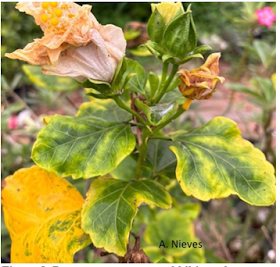
Description and Damage: The two-spot cotton leafhopper is a tiny green insect with distinctive dark spots on its wings and sometimes on its head. These pests feed on the lower surface of leaves, causing a condition known as “hopperburn,” which leads to yellowing, reddening, browning, wilting, and curling of leaves. The damage can be extensive, with yield losses exceeding 50% in some crops.
Photo by Alondra Nieves, graduate student, UPRM, PR.
Photo by Brittany Atkinson, Manatee County Community Gardens Program
Hosts and Economic Importance: This pest affects a variety of crops, including cotton, okra, eggplant, sunflowers, and roselle. However, it also poses a threat to ornamental plants, particularly certain cultivars of hibiscus. While some hibiscus varieties may only be lightly colonized, others can suffer extensive damage, impacting their aesthetic value and health. This pest also feeds on marigolds in the Asteraceae family, mulberry in the Moraceae family, as well as some members of the grass family.
Distribution and Action: The two-spot cotton leafhopper is native to the Indian Subcontinent but has spread to the Caribbean and several Florida counties. If large numbers of leafhoppers are found, samples should be sent to the Florida Department of Agriculture and Consumer Services for identification.
Conclusion: The establishment of the two-spot cotton leafhopper in the Caribbean and Florida poses a significant threat to both agricultural and ornamental plants. Early detection and proper management are crucial to mitigate the impact of this pest.
For more information or to report sightings, contact the Florida Department of Agriculture and Consumer Services at DPIHelpline@FDACS.gov or 1-888-397-1515
References :
USDA APHIS, 2023. Amrasca biguttula (Ishida)
(Hemiptera: Cicadellidae)
Indian cotton leafhopper. Amrasca biguttula 18x24 PPQ.pdf
FDACS DPI, 2023. Two-spot cotton leafhopper, Hemiptera: Cicadellidae, Typhlocybinae, Empoascini; Amrasca biguttula
(Ishida) – A serious pest of cotton, okra and eggplant that has become established in the Caribbean
Basin. PEST ALERT: Two-spot cotton leafhopper




 Posts

